What does SNR mean?
SNR stands for Single Number Rating: a single value in decibels that sums up the average sound attenuation of a hearing protector. It comes from a laboratory test with test subjects and is calculated according to EN ISO 4869-2. With the SNR method, it is subtracted from the C-weighted level at the workplace to give the A-weighted level at the ear. According to DGUV Rule 112-194 of the German Social Accident Insurance, the SNR is on average 3 to 4 dB higher than the M value and describes the attenuation only roughly.
In practice, hearing protection rarely fits as perfectly as in the laboratory. For selection, DGUV Rule 112-194 therefore subtracts a real-world deduction from the M or L value: 9 dB for foam earplugs that are shaped before use, 5 dB for pre-moulded earplugs, banded earplugs and earmuffs, 3 dB for custom-moulded earplugs with a function check. In the UK, the Health and Safety Executive recommends derating every protector by 4 dB to allow for real-world factors. Our calculations use the DGUV deductions.
How the value is determined
In the test laboratory, test subjects wear the hearing protector, and their hearing threshold is measured with and without protection in octave bands from 125 to 8000 Hz. For each band this gives a mean attenuation and a standard deviation. The mean minus one standard deviation is the assumed protection value (APV). Around 84 per cent of wearers achieve this attenuation, which is why newer user instructions often state H84, M84 and L84.
The complete table with the values per frequency is in every set of user instructions under “minimum attenuation”. For EarProtect you will find it on every product page under Downloads.
H, M and L: high, medium and low frequencies
H, M and L give the attenuation for high-frequency (H), medium-frequency (M) and low-frequency (L) noise. For selection, DGUV Rule 112-194 divides workplace noise into two classes: medium to high frequency (HM), such as grinding, sawing and compressed air, and predominantly low frequency (L), such as excavators, piston compressors and blasting equipment.
An example from the range: the EP903 earmuffs have an SNR of only 29 dB, but H 36 dB, and so attenuate high frequencies more than the EP902 with SNR 33 dB (H 34). For low frequencies it is the other way round: L 18 versus L 23 dB.
| Noise class | Examples from the DGUV rule | Calculate with |
|---|---|---|
| HM, medium to high frequency (LC − LA ≤ 5 dB) | Grinders and cut-off grinders, woodworking machines, compressed air nozzles, impact wrenches, electric nailers, bottling plants | M value |
| L, predominantly low frequency (LC − LA > 5 dB) | Excavators, bulldozers, piston compressors, blasting equipment, metal die-casting machines, furnaces | L value |
How to calculate the level at the ear
For everyday use, DGUV Rule 112-194 describes the HML check: the noise is classed as medium to high frequency or low frequency, then level at the ear = noise level − (M − real-world deduction), or for low-frequency noise noise level − (L − real-world deduction). Example: grinding workplace at 100 dB(A), EP1227 disposable foam earplugs with M 35 dB, deduction 9 dB: 100 − (35 − 9) = 74 dB(A) at the ear. That is within the recommended range of 70 to 80 dB(A).
Simply subtracting the SNR from the A-weighted level, on the other hand, is inaccurate: the SNR method requires the C-weighted level. More accurate than the HML check are the HML method with A- and C-weighted levels and the octave band method; both need measurements from the workplace.
Only those who use hearing protection in a qualified way may calculate without the real-world deduction: training with practical exercises at least four times a year, documented. This is set out in DGUV Rule 112-194, section 6.2.5. How such training works is described under Hearing protection training.
More attenuation is not automatically better. Below 70 dB(A) at the ear, this is called overprotection: warning signals and speech are harder to hear.
Attenuation values of all EarProtect products
| Product | SNR | H | M | L | Deduction | Recommended, HM noise | Recommended, L noise |
|---|---|---|---|---|---|---|---|
| Disposable foam earplugs EP1227BWG | 37 | 37 | 35 | 30 | 9 dB | 96–106 dB(A) | 91–101 dB(A) |
| Corded foam earplugs EP1227CBWG | 37 | 37 | 35 | 30 | 9 dB | 96–106 dB(A) | 91–101 dB(A) |
| Disposable earplugs in a storage case EP1227BWGB | 37 | 37 | 35 | 30 | 9 dB | 96–106 dB(A) | 91–101 dB(A) |
| Detectable earplugs in blue EP1227BD | 37 | 37 | 35 | 30 | 9 dB | 96–106 dB(A) | 91–101 dB(A) |
| Reusable silicone earplugs EP001Y | 32 | 32 | 29 | 28 | 5 dB | 94–104 dB(A) | 93–103 dB(A) |
| Reusable TPE earplugs EP002B | 32 | 33 | 29 | 28 | 5 dB | 94–104 dB(A) | 93–103 dB(A) |
| Banded earplugs EP100BY | 29 | 32 | 26 | 24 | 5 dB | 91–101 dB(A) | 89–99 dB(A) |
| Banded earplugs with conical tips EP102BO | 27 | 30 | 24 | 22 | 5 dB | 89–99 dB(A) | 87–97 dB(A) |
| EP902 earmuffs EP902 | 33 | 34 | 31 | 23 | 5 dB | 96–106 dB(A) | 88–98 dB(A) |
| EP901 earmuffs EP901 | 31 | 33 | 29 | 21 | 5 dB | 94–104 dB(A) | 86–96 dB(A) |
| EP906 earmuffs EP906 | 30 | 33 | 28 | 20 | 5 dB | 93–103 dB(A) | 85–95 dB(A) |
| EP903 earmuffs EP903 | 29 | 36 | 26 | 18 | 5 dB | 91–101 dB(A) | 83–93 dB(A) |
| EP905 earmuffs EP905 | 29 | 34 | 26 | 19 | 5 dB | 91–101 dB(A) | 84–94 dB(A) |
| EP904 earmuffs EP904 | 28 | 33 | 25 | 18 | 5 dB | 90–100 dB(A) | 83–93 dB(A) |
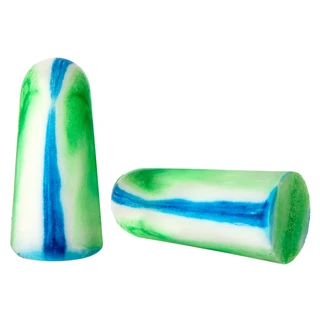
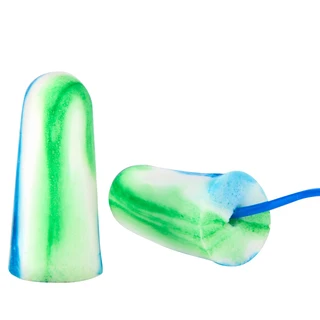
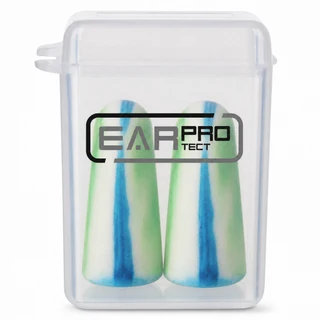
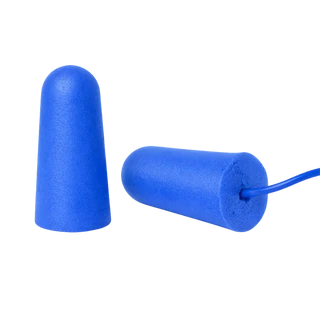
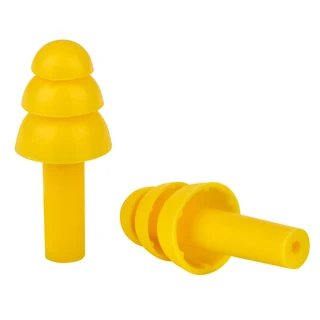
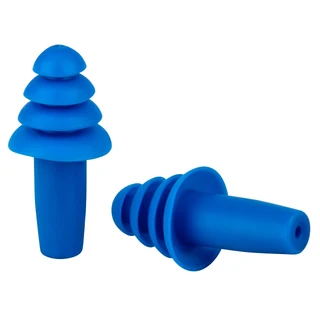
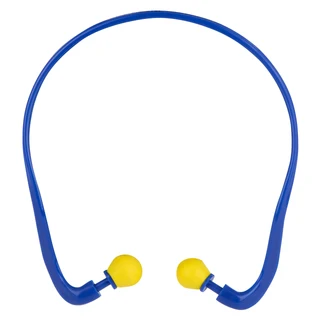
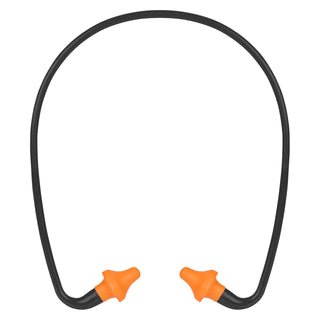
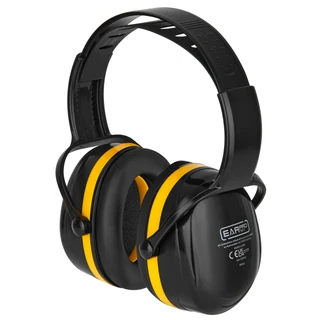
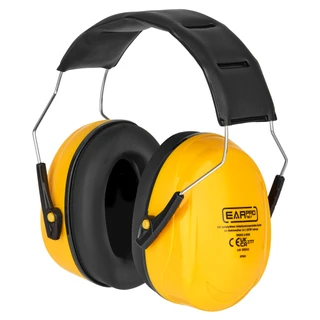
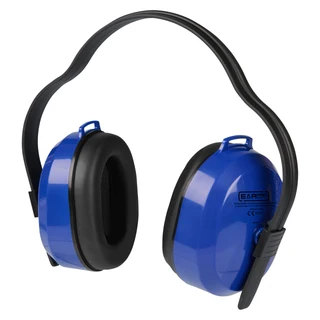
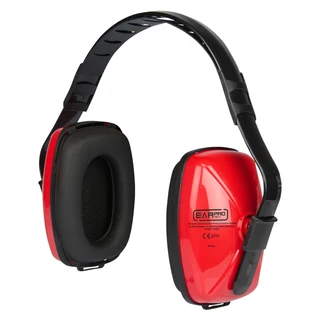
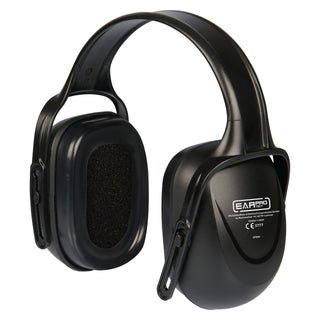
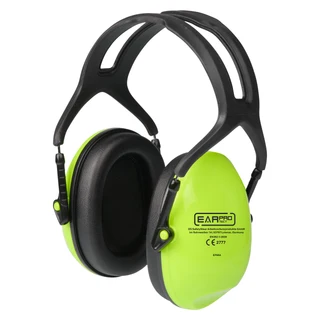
All values in dB. Recommended: workplace levels with 70 to 80 dB(A) at the ear according to the HML check of DGUV Rule 112-194, HM = mid- to high-frequency noise (M − deduction), L = low-frequency noise (L − deduction).
Frequently asked questions
What is a good SNR value?
The SNR alone does not tell you. What matters is what reaches the ear: 70 to 80 dB(A), calculated with the M or L value minus the real-world deduction. At 100 dB(A), an effective attenuation of 20 to 30 dB is right; at 90 dB(A), very strong hearing protection tends to be too much.
Is SNR 37 better than SNR 30?
Not necessarily. SNR 37 attenuates more, but at moderate levels it can lead to overprotection. What matters is the level at the ear.
What does H 34, M 31, L 23 mean?
The hearing protector attenuates high frequencies by 34 dB, medium frequencies by 31 dB and low frequencies by 23 dB. The values come from the EU type-examination according to EN 352.
Where can I find the SNR value?
On the packaging and in the user instructions. For EarProtect, it is also on every product page and in the data sheet.