The certificate as an image
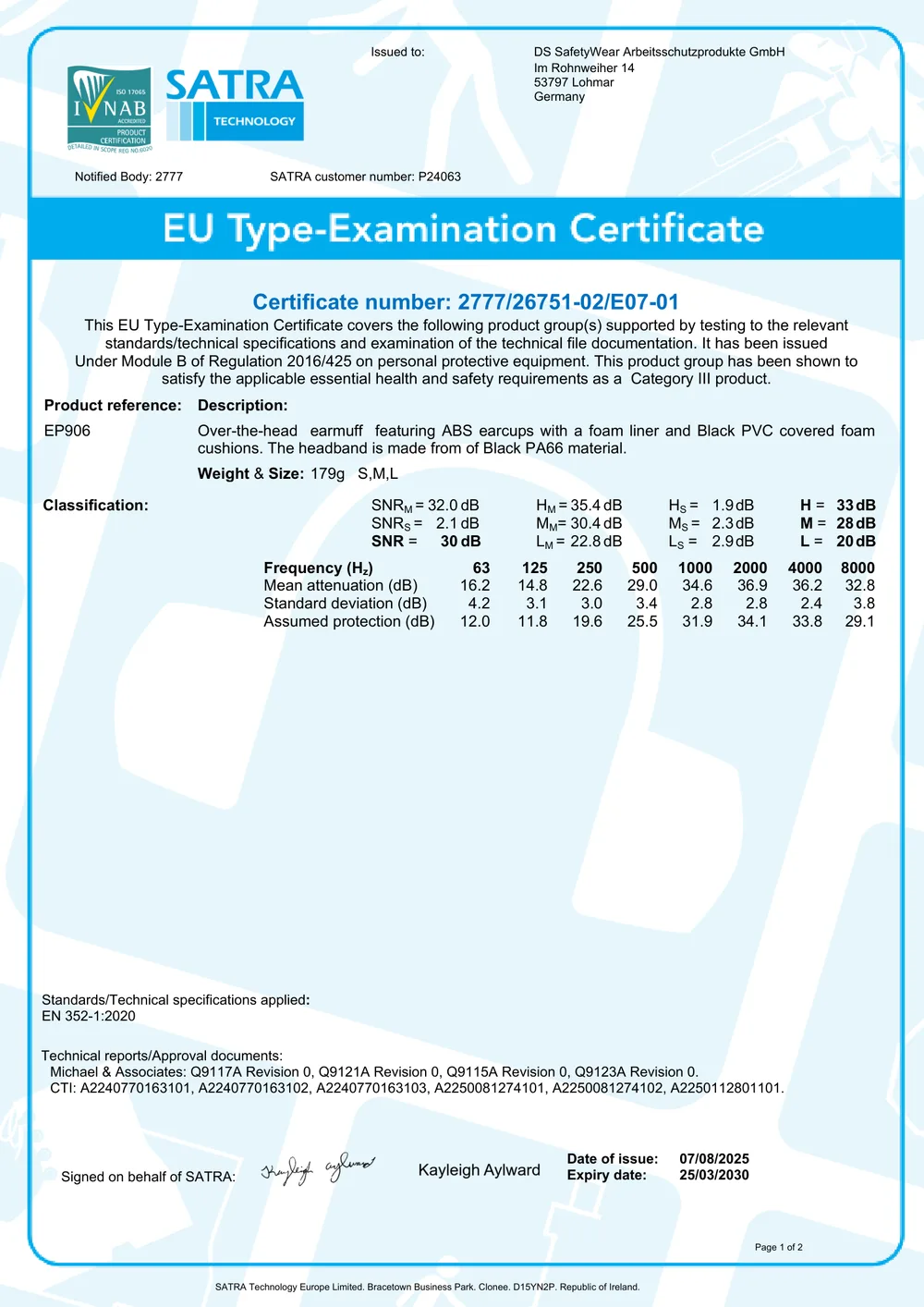
The certificate shows that the design of the EP906 meets the essential requirements of Regulation (EU) 2016/425. How the procedure for category III PPE works is explained in CE marking on hearing protection. The structure of an earplug certificate is explained in Reading an EU type-examination certificate: the EP1227 certificate.
Field by field
| Field | Entry on the certificate | Meaning |
|---|---|---|
| Issuer | SATRA Technology Europe Limited, Clonee (Ireland), Notified Body 2777 | Notified body under the PPE Regulation. Its four-digit identification number follows the CE mark. The accreditation mark for product certification under ISO 17065 is shown. |
| Issued to | DS SafetyWear Arbeitsschutzprodukte GmbH | The manufacturer and holder of the certificate. |
| Certificate number | 2777/26751-02/E07-01 | Unique number; it also appears in the product’s EU declaration of conformity. |
| Issue and expiry | 07/08/2025 to 25/03/2030 | Period of validity. The body may withdraw the certificate if manufacture, design, materials or packaging change (page 2). |
| Procedure and category | Module B of Regulation (EU) 2016/425, category III | EU type-examination. For CE marking, ongoing production supervision under module C2 or D is added. |
| Standard applied | EN 352-1:2020 | Part 1 of the EN 352 series: earmuffs (earplugs are in part 2). More under EN 352. |
| Product reference and description | EP906: over-the-head earmuff with ABS earcups with a foam liner and black PVC-covered foam cushions; headband made of black PA66 | Describes the tested product, including components and materials. If the product later deviates, the manufacturer must inform SATRA. |
| Weight and size | 179 g; S, M, L | Weight of the hearing protector and the sizes tested. The weight is also on the EP906 product page. |
| Classification | SNR 30 dB; H 33 dB, M 28 dB, L 20 dB | Laboratory attenuation values, see the next section. |
| Technical reports | Test reports from Michael & Associates and CTI | Basis of the examination. The reports belong to the manufacturer’s technical documentation. |
How to read the attenuation values
For SNR, H, M and L the certificate gives a mean (subscript M), a standard deviation (subscript S) and the classified value. The classified value is close to the mean minus the standard deviation; because the tenths are shown rounded, a difference such as 33.5 dB can give a classified value of 33 dB.
| Value | Mean | Standard deviation | Mean minus standard deviation | Classified |
|---|---|---|---|---|
| SNR | 32.0 | 2.1 | 29.9 | 30 |
| H (high frequencies) | 35.4 | 1.9 | 33.5 | 33 |
| M (medium frequencies) | 30.4 | 2.3 | 28.1 | 28 |
| L (low frequencies) | 22.8 | 2.9 | 19.9 | 20 |
| Frequency (Hz) | 63 | 125 | 250 | 500 | 1000 | 2000 | 4000 | 8000 |
|---|---|---|---|---|---|---|---|---|
| Mean attenuation | 16.2 | 14.8 | 22.6 | 29.0 | 34.6 | 36.9 | 36.2 | 32.8 |
| Standard deviation | 4.2 | 3.1 | 3.0 | 3.4 | 2.8 | 2.8 | 2.4 | 3.8 |
| Assumed protection | 12.0 | 11.8 | 19.6 | 25.5 | 31.9 | 34.1 | 33.8 | 29.1 |
Noticeable is the lower attenuation at low frequencies: at 63 and 125 Hz the assumed protection is about 12 dB, at 2000 Hz more than 34 dB. According to DGUV Rule 112-194 in Germany, earmuffs usually attenuate low frequencies less than earplugs, which is why the L value deserves a look (SNR and H/M/L explained). For practice, the rule provides a 5 dB deduction for earmuffs; the UK HSE recommends a 4 dB real-world deduction. The values of all models are under attenuation values.
The certificates of all six earmuffs
| Model | Certificate number | Issued | Valid until | SNR | H / M / L | Weight | |
|---|---|---|---|---|---|---|---|
| EP901 | 2777/13329-03/E07-01 | 14/10/2024 | 19/01/2028 | 31 | 33 / 29 / 21 | 205 g | |
| EP902 | 2777/13328-03/E09-01 | 14/10/2024 | 18/05/2028 | 33 | 34 / 31 / 23 | 262 g | |
| EP903 | 2777/13060-04/E07-01 | 11/08/2025 | 19/01/2028 | 29 | 36 / 26 / 18 | 182 g | |
| EP904 | 2777/26527-01/E04-01 | 07/08/2025 | 17/12/2029 | 28 | 33 / 25 / 18 | 217 g | |
| EP905 | 2777/13075-04/E11-01 | 07/08/2025 | 18/05/2028 | 29 | 34 / 26 / 19 | 151 g | |
| EP906 | 2777/26751-02/E07-01 | 07/08/2025 | 25/03/2030 | 30 | 33 / 28 / 20 | 179 g |
Validity differs by model, which is why it is in the table. The figures match the product pages and the attenuation values page.
Page 2: the conditions
The conditions on page 2 are the same on all SATRA certificates: for category III products, CE marking depends on current compliance under module C2 or D, the manufacturer reports changes to the product and the technical documentation, production is limited to the sites named in the documentation and the English version is authoritative where translations exist. A detailed explanation is in the article on the EP1227 certificate.
Checking the issuing body
All six certificates come from SATRA Technology Europe (identification number 2777). Whether this body is notified for hearing protection can be checked in the European Commission’s NANDO database: the entry satra Technology Europe Ltd lists, under Regulation (EU) 2016/425, among others “Equipment providing hearing protection” and “Protective Equipment against harmful noise”, with EU type-examination (annex V) and the procedures of annexes VII and VIII (viewed on 18 October 2026). How NANDO works and why voluntary certificates do not replace proof of conformity is in CE marking and PPE category III. The two-step assessment with certificate and production supervision is described by the Commission’s Blue Guide in section 5.1.5.
Further documents
Declarations of conformity, user instructions and data sheets are on the data sheets page. Which hearing protection suits which workplace is shown by the hearing protection finder.
Frequently asked questions
Does every EarProtect earmuff have its own certificate?
Yes. For EP901, EP902, EP903, EP904, EP905 and EP906 there is one EU type-examination certificate each from SATRA Technology Europe (notified body 2777), all under EN 352-1:2020. Numbers, dates and PDFs are in the table above.
How long is the EP906 certificate valid?
It was issued on 7 August 2025 and is valid until 25 March 2030. The body may withdraw it earlier if manufacture, design, materials or packaging change.
What does EN 352-1:2020 on the certificate mean?
EN 352-1 is the part of the standard series for earmuffs. Earplugs are tested under part 2. The 2020 edition is the basis of the EP906 examination.
What does “Weight & Size: 179 g, S, M, L” mean?
It is the weight of the hearing protector and the sizes tested, S, M and L. The weight of 179 g is also on the EP906 product page.
Why do earmuffs attenuate low frequencies less?
According to DGUV Rule 112-194, earmuffs usually attenuate low frequencies less than earplugs. For the EP906 the frequency table shows it: at 63 and 125 Hz the assumed protection is about 12 dB, and the L value is 20 dB.
Which real-world deduction applies to earmuffs?
DGUV Rule 112-194 in Germany provides a 5 dB deduction from the M or L value for earmuffs; the UK HSE recommends 4 dB. The hearing protection finder calculates the residual level at the ear.
Why is the certificate in English?
SATRA issues it in English. Under the conditions on page 2, the English version is authoritative where translations exist.
Sources
- Regulation (EU) 2016/425 on personal protective equipment
- DGUV Rule 112-194, chapter 3 General (CE marking, product marking, issue of hearing protection), in German
- DGUV Rule 112-194, chapter 6 Selection (attenuation, ergonomics, work environment, signal audibility), in German
- DIN Media: DIN EN 352-2:2024-09 (German version of EN 352-2:2020+A1:2024)
- Commission Implementing Decision (EU) 2026/1279 on harmonised standards for personal protective equipment, Annex I (EN 352-1 to -10) and Annex II (withdrawn versions), OJ of 16 June 2026
- HSE: Accounting for “real world” factors in hearing protection
- European Commission: NANDO (New Approach Notified and Designated Organisations), database of notified bodies
- NANDO: entry satra Technology Europe Ltd, identification number 2777, notification under Regulation (EU) 2016/425 (hearing protection), checked on 18 October 2026
- Commission Notice: The ‘Blue Guide’ on the implementation of EU product rules 2022, 2022/C 247/01, Official Journal C 247 of 29 June 2022